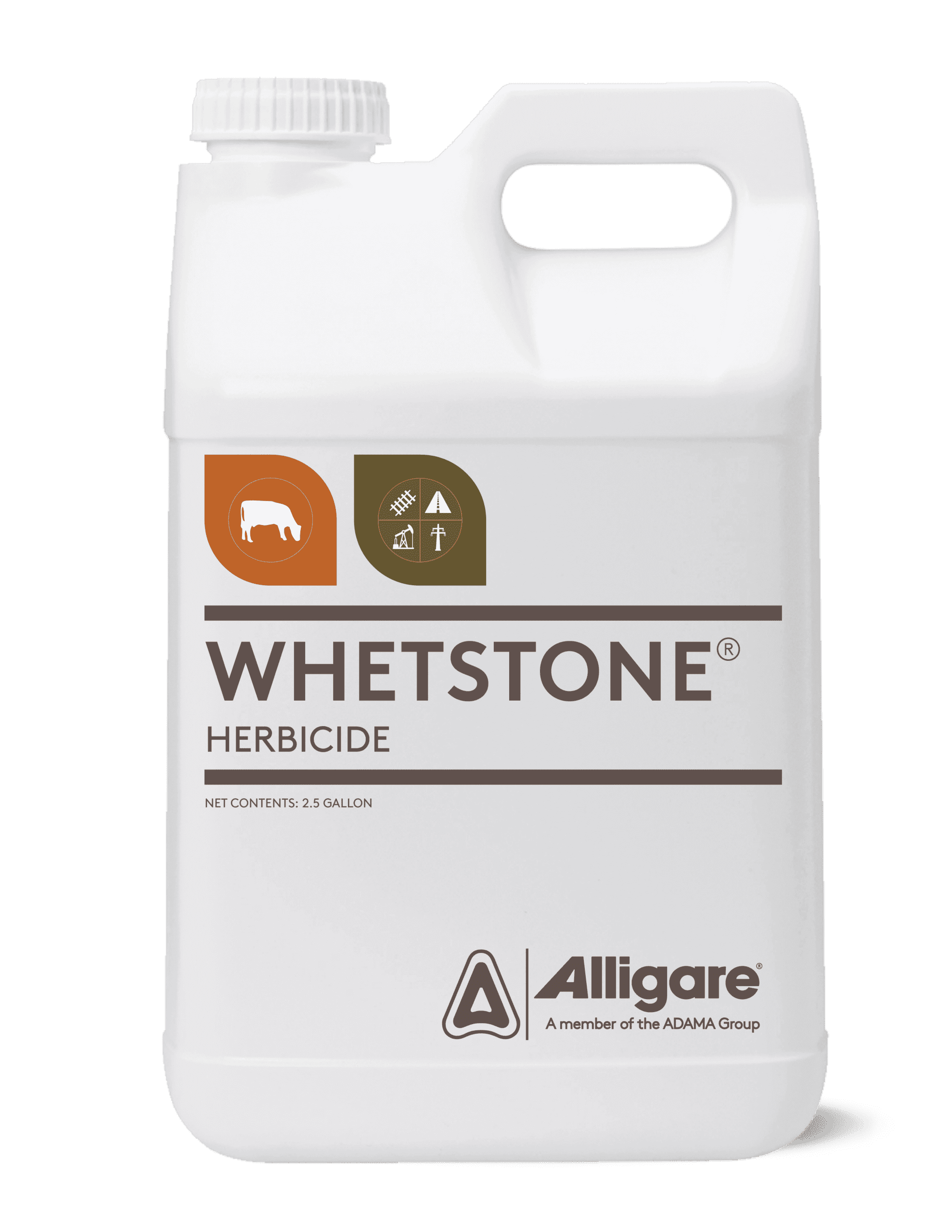
WHETSTONE® HERBICIDE

A reliable partner for superior, yet selective, control of numerous broadleaf weeds, vines, and woody plants

FIND A REP

Performance Highlights

As a flexible, pre- and post-emergent product, Alligare’s Whetstone is a tank-mix friendly formula that provides residual control of invasive and noxious vegetation in a variety of settings.

  • Broad spectrum control of 185 annual, biennial, and perennial weeds and brush
  • Provides extended pre- and post-emergent control of susceptible species
  • Approved for treating vegetation in areas grazed by livestock, with no restrictions
  • Increases weed spectrum of broadleaf species when included in bare-ground applications
  • Registered under the EPA’s Reduced Risk Pesticide Initiative

AMINOPYRALID STEWARDSHIP

Though not classified as a hazardous substance or mixture and the product has no grazing restrictions as such, applicators and end-users should know that waste produced from animals consuming grasses or hay treated with animopyralid may retain enough active ingredients to harm sensitive broadleaf plants. Applicators and end-users should carefully follow product labels regarding warning s or restrictions for manure use.

CASE PACK/PALLET:

(2 x 2.5 gal) per case/ 180 gals per pallet
(6 x 1 qt) per case/480 qts per pallet

States registered: AL, AK, AZ, AR, CA, CO, CT, DE, DC, FL, GA, HI, ID, IL, IN, IA, KS, KY, LA, ME, MD, MA, MI, MN, MS, MO, MT, NE, NV, NH, NJ, NM, NY, NC, ND, OH, OK, OR, PA, RI, SC, SD, TN, TX, UT, VT, VA, WA, WV, WI, WY

Applicators and other handlers must wear:

  • Long-sleeved shirt and long pants
  • Shoes plus socks

  • Black locust
  • Carolina horsenettle
  • Curly dock
  • Horseweed
  • Silverleaf nightshade
  • Knapweed
  • Kudzu
  • Lespedeza (annual)
  • Mimosa
  • Buffalo bur
  • Puncturevine
  • Ragweed
  • Spanish needle
  • Teasel
  • Cocklebur
  • Thistles
  • Tree of heaven
  • Tropical soda apple
  • Wisteria
  • Iron weed

  • rangeland/permanent grass pastures
  • railroad and utility rights-of-way
  • natural areas and wildlife habitats
  • roadsides and other unimproved turf grasses
  • fencerows and storage areas
  • non-irrigation ditch banks
  • industrial and utility plant sites
  • Conservation Reserve Program (CRP) lands

See product label for complete list

News & Insights

  • Building Better Pastures through Optimal Soil Nutrition
    Productive pastures do not happen by chance. They are built from the ground up, starting with a thoughtful approach to soil nutrition. When soil health is managed with intention, the result is higher-quality forage, improved livestock performance, and a more resilient grazing system that pays dividends year after year. Read more
  • Broadleaf Weed Control: A Proven Tool for Rangeland Management
    GRASS INTO GAINS  WITH ALLIGARE RANGE & PASTURE Broadleaf weed control on rangelands has been a cornerstone of effective land management for decades. Since the introduction of 2,4-D in the 1940s, land managers have had access to a powerful tool that selectively targets broadleaf plants while leaving grasses intact. This revolutionary herbicide made it possible to reshape and enhance pastureland without disturbing the valuable grass species that serve as the foundation of forage systems. Over the years, many new active ingredients have been introduced to the market and this practice has become standard among livestock producers, conservationists, and landowners seeking to improve the productivity, safety, and ecological health of their rangelands. The benefits are broad and well-documented: increased forage production, delayed or prevented brush encroachment, reduced presence of poisonous plants, and support for land restoration efforts.Read more
  • Optimizing Grazing Efficiency through Strategic Prickly Pear Management
    Opuntia, more commonly known as prickly pear, is a well-recognized symbol of the Southwest, but for land managers and livestock producers, it often represents a persistent challenge. While several species are native to the region, invasive species originating from Central America and the West Indies have also become established. Whether growing horizontally across the ground or standing vertically at heights exceeding six feet, prickly pear can significantly disrupt grazing operations. Its dense structure and sharp spines limit access to desirable forage, reduce pasture productivity, and deter cattle from grazing effectively.Read more
  • Fall Herbicide Applications: The Key to Reducing Spring Weed Pressure
    Successful weed and brush control doesn't start in the spring. It starts now, with proactive fall herbicide applications.Read more

Subscribe to Our Newsletter