
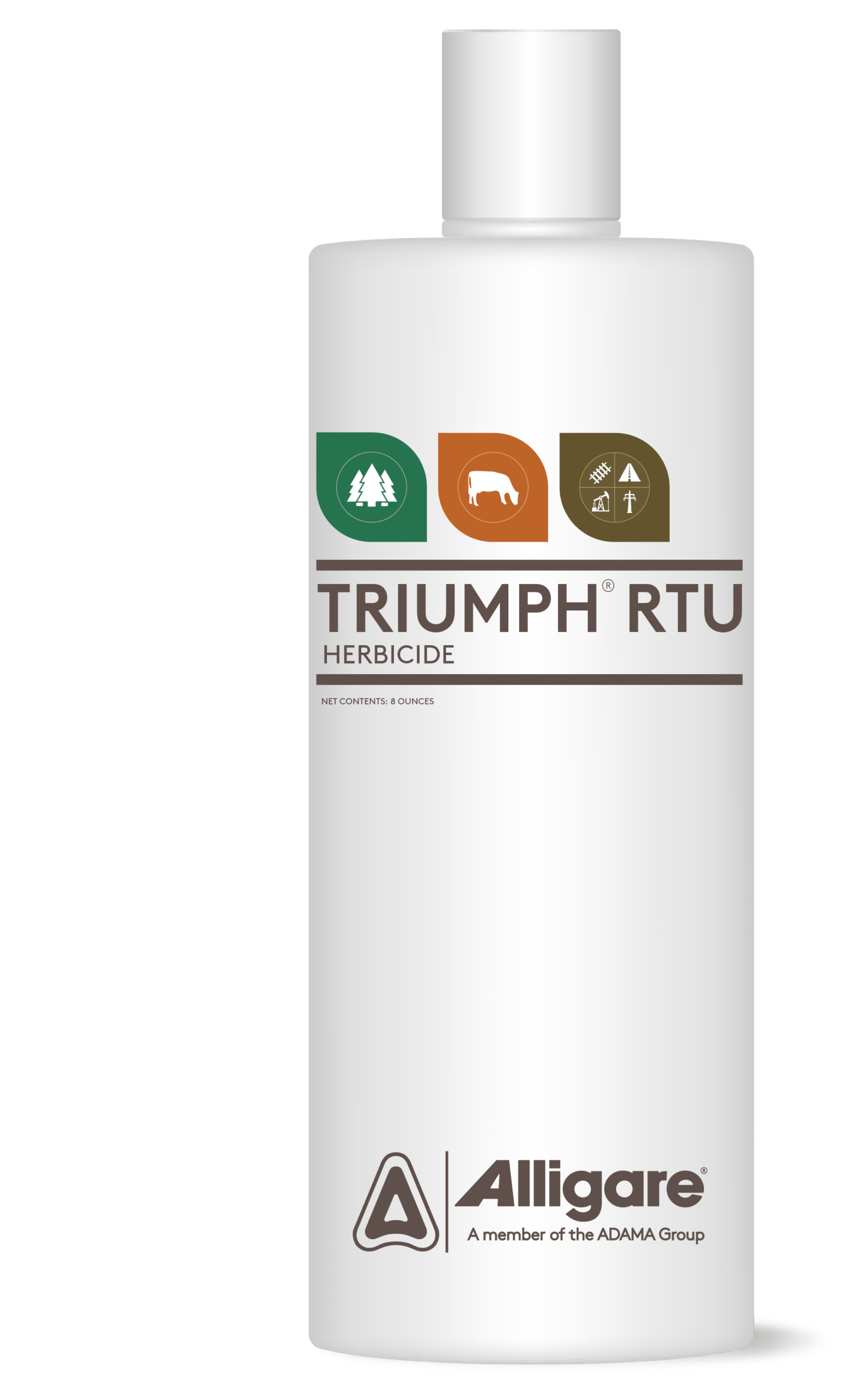
TRIUMPH® RTU
Convenient and effective control of unwanted woody plants in a ready-to-use 1-quart squirt bottle. No mixing or measuring is required. Blue dye is included that allows the applicator to readily view the application to make sure it is complete.
Performance Highlights
Alligare’s Triumph RTU Herbicide is a ready-to-use product that is effective for killing unwanted trees and preventing undesirable sprouting of cut trees.
- Ready-to-use (“RTU”) formula in a convenient 1-quart squirt bottle
- No mixing or measuring required
- Blue dye is included that allows the applicator to readily view the application to make sure it is complete
- Controls many woody plant species
- Treatment applications can be made any time during the year
- Case Pack/Pallet:
(6 x 1 qt) per case/480 qts per pallet - For the most current registration information, call (888) 255-4427.
States registered: AL, AR, CO, CT, DE, DC, FL, GA, HI, ID, IL, IN, IA, KS, KY, LA, MD, MI, MN, MS, MO, MT, NE, NV, NH, NJ, NM, NC, ND, OH, OK, OR, PA, RI, SC, SD, TN, TX, UT, VT, VA, WA, WV, WI, WY
Applicators and other handlers must wear:
- Long-sleeved shirt and long pants
- Chemical-resistant gloves Category C, such as barrier laminate ≥ 14 mils, butyl rubber ≥ 14 mils, nitrile rubber ≥ 14 mils, neoprene rubber ≥ 14 mils, polyvinyl chloride (PVC) ≥ 14 mils, or Viton ≥ 14 mils
- Shoes plus socks
- Protective eyewear
- For containers over 1 gallon, but less than 5 gallons: mixers and loaders who do not use mechanical system (such as a probe and pump or spigot) to transfer the contents of this container must also wear coveralls or a chemical-resistant apron
- Ailanthus
- Cedar
- Firs
- Hickory
- Pecan
- Alder
- Cherry
- Green ash
- Hawthorn
- Persimmon
- Aspen
- Dogwood
- Gum
- Maples
- Serviceberry
- Birch
- Elm
- Hawthorn
- Oaks
- Sourwood
See product label for complete list.
- forest sites
- fencerows
- rights-of-way
- non-cropland areas
- roadsides
See product label for complete list.
